
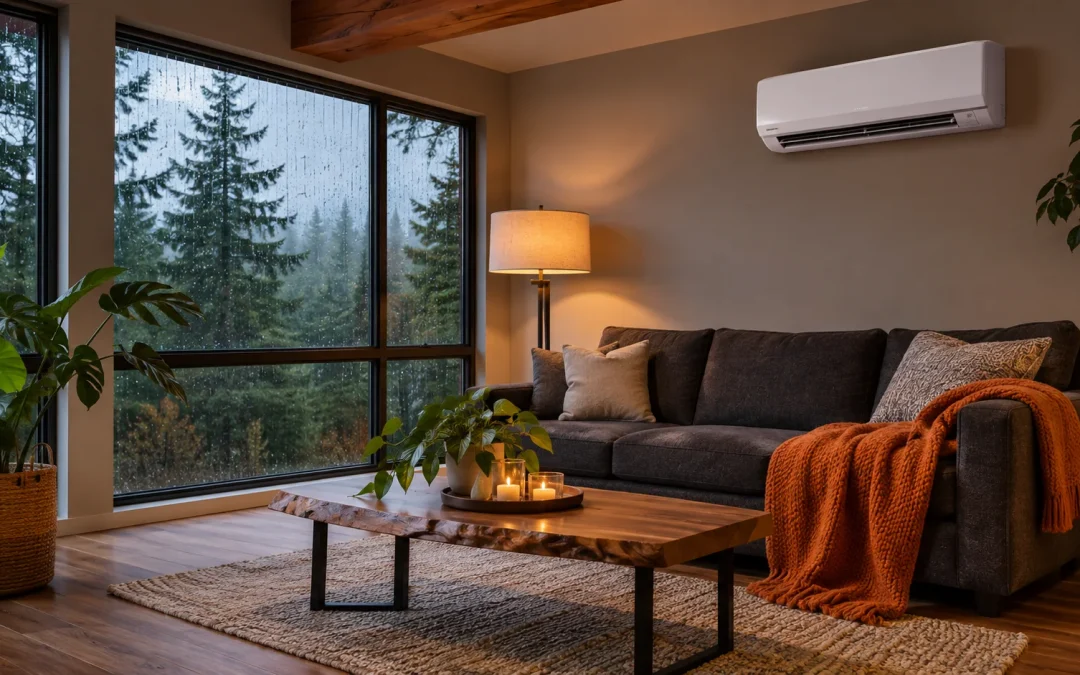
If you have ever lived through a Portland winter in a room the furnace never quite reaches, or a summer heat wave in an upstairs bedroom, you have probably heard someone mention ductless mini-splits. They are quiet, efficient, and do not require new ductwork. But are they actually worth it here, where winters are damp and mild most of the time and then suddenly are not?
Here is an honest look at how ductless heat pumps work, where they shine in our climate, and when they may not be the right fit.
How a ductless mini-split works
A mini-split is a heat pump with two parts: an outdoor unit and one or more indoor heads mounted on a wall, ceiling, or tucked into a low-profile cabinet. A small line set connects them through a hole about the size of a coffee can. Instead of burning fuel to create heat, the system moves heat. In winter it pulls heat from the outdoor air and delivers it inside. In summer it reverses and works as an air conditioner.
Because each indoor head has its own controls, you heat or cool the rooms you are actually using instead of the whole house.
Do they work when it gets cold?
This is the most common question we hear, and the answer has changed a lot over the last decade. Today’s cold-climate models use variable-speed compressors designed to keep producing heat well below freezing. ENERGY STAR certifies cold-climate heat pumps after testing their performance at 5 degrees Fahrenheit, which is colder than most of the Willamette Valley sees in a typical year.
For greater Portland, the coast, and the valley, a properly sized cold-climate system can handle most or all of the heating load in the spaces it serves. In the Gorge and at higher elevations, where east winds and ice storms hit harder, equipment selection and sizing matter even more. That is a conversation to have during the estimate, not a guess to make from a spec sheet.
Where mini-splits make the most sense
- Homes with baseboard or wall heaters: ENERGY STAR notes that a certified mini-split can cut heating costs roughly in half compared with conventional electric heating.
- Rooms the furnace cannot reach: bonus rooms, additions, upstairs bedrooms, and finished basements.
- Homes without air conditioning: one system covers winter heating and summer cooling.
- Garages, studios, and ADUs: spaces where running ductwork would be expensive or impractical.
When it might not be the best fit
Honest advice matters here. If your home already has a well-performing ducted heat pump or furnace and every room is comfortable, a mini-split may not add enough value to justify the cost. Some homeowners also prefer not to see an indoor head on the wall, though concealed and ceiling cassette options can help. We will walk you through the tradeoffs before you commit to anything.
What to expect from a Hardline install
Our team is trained and certified on the systems we install, and we source equipment directly. A good installation starts with sizing the system to your rooms, not just picking a unit off a chart. From there, we plan clean line-set routing, place the outdoor unit where it can breathe and shed water and snow, and set up controls so the system is simple to live with.
We also service what we install. Like a fireplace, a mini-split performs best with periodic cleaning of filters and coils.
What about rebates and incentives?
Utility and state programs for heat pumps change often, and eligibility depends on your home and your current heating system. Rather than quote numbers that may be out of date, ask us about current incentives when you request your estimate and we will point you to what applies.
The bottom line
For many homes in our area, a ductless mini-split is one of the most practical comfort upgrades available: efficient heat in winter, cooling in summer, and comfort in the rooms that have never felt quite right.
Curious whether a mini-split fits your home? Call 971-727-5019, email hello@hardlinehh.com, or reach out to our team to request an estimate. You can also see all of our home comfort services.
Recent Comments