
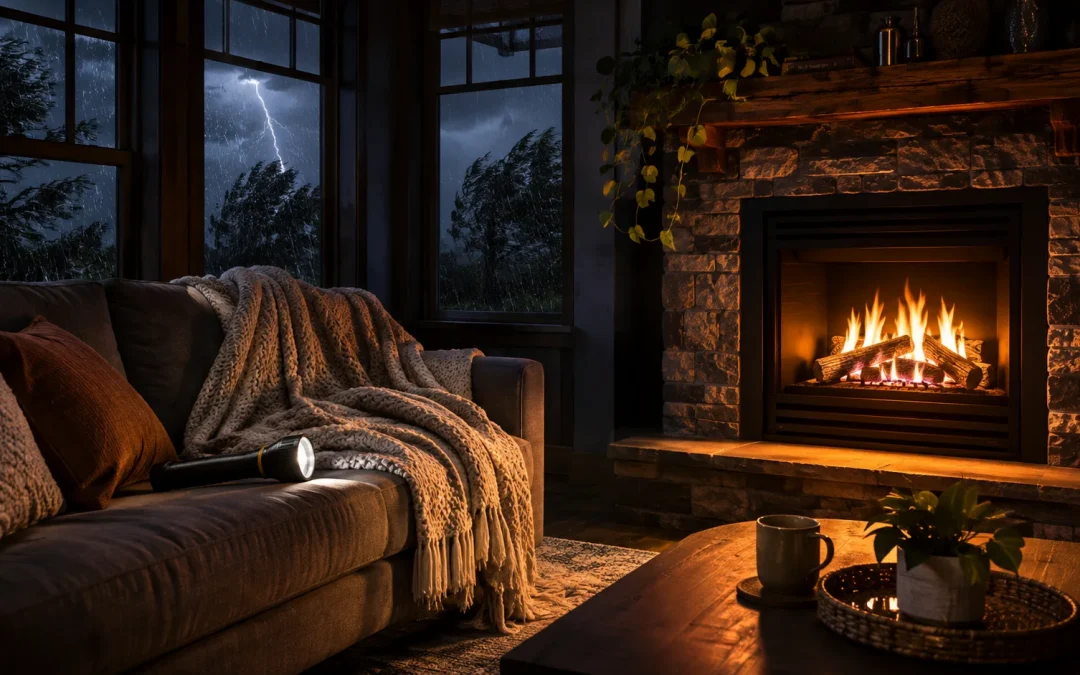
Winter storms in Oregon have a way of arriving all at once. An ice storm rolls through the Gorge, east winds knock down a few branches, and suddenly the house is dark and the furnace is silent. A forced-air furnace needs electricity to run its blower, so when the power goes out, so does the heat. That is when many homeowners discover just how valuable a gas fireplace can be.
The good news: many gas fireplaces can provide heat and light during an outage. Whether yours will depends on how it lights.
Standing pilot fireplaces: usually ready to go
Many gas fireplaces use a standing pilot, also called a millivolt system. A small pilot flame heats a thermopile, which generates enough electricity on its own to open the gas valve. No household power is needed. If your fireplace has a standing pilot, it should keep working normally during an outage, including wall switches and many thermostats that run on that same millivolt power.
If the pilot is already lit, simply turn the fireplace on as usual. If the pilot is off, most standing pilot fireplaces light with a push-button igniter (the clicking button on the control valve), which also does not need household power.
What about lighting the pilot by hand?
We get this question a lot. If the push-button igniter is not sparking, some owner’s manuals include a manual lighting procedure for the pilot. Others do not allow it. The rule is simple: only light the pilot manually if your owner’s manual describes how, and follow those steps exactly. Your manual and the lighting instructions plate near the controls are written for your specific model. If you cannot find your manual, the model number on the rating plate is usually enough for us to help you track it down.
And as always, if you smell gas, do not try to light anything. Leave the house and call your gas utility from outside.
Electronic ignition fireplaces: check for battery backup
Many newer fireplaces use electronic ignition (often called IPI, for intermittent pilot ignition). Instead of a pilot that burns all the time, the system sparks the pilot only when you turn the fireplace on, and that spark normally uses household power. Many of these models include a battery backup that lets the fireplace light and run during an outage. The battery type and location vary by manufacturer, so check your manual now, before you need it.
What will not work without power
- Blowers and fans: the fireplace still produces radiant heat, but the fan that pushes warm air into the room will not run.
- Some power-vented units: fireplaces that rely on an electric power vent generally cannot run during an outage.
- Accent lighting and some smart controls: these usually need household power.
Get ready before the next storm
- Find your owner’s manual and read the lighting and power outage sections.
- Figure out whether you have a standing pilot or electronic ignition.
- If you have battery backup, put fresh batteries in it and keep spares with your flashlights.
- Replace the batteries in your remote and in your smoke and carbon monoxide alarms.
- Schedule a fireplace service so the pilot, valve, and venting are clean and working before storm season.
Thinking about backup heat?
If your current fireplace cannot run without power, or you do not have a fireplace at all, a new gas fireplace or insert with the right ignition system can be a smart addition to your home’s storm plan. We can walk you through ignition options, venting, and placement, and handle the gas line, installation, and finish work as one project.
Honest advice, any time of year
Every fireplace is a little different, and we are always happy to look at yours and tell you exactly how it will behave when the lights go out. Hardline Hearth & Home serves homeowners across greater Portland, out to the coast and Hood River, and down to Eugene.
Want to know if your fireplace is storm ready? Call 971-727-5019, email hello@hardlinehh.com, or reach out to our team to schedule a service or request an estimate.
Recent Comments